
New Cards for BISP July 2025
In July 2025, the BISP plans to issue 200,000 new payment cards with the goal of giving Pakistan’s most disadvantaged households better access to quarterly payments. Beneficiaries can use these cards to withdraw the most recent installment of Rs. 13,500 in a straightforward, safe, and modern manner. The government wants the system to be safer, more transparent, and helpful to low-income families. Information on eligibility requirements, new payment withdrawal methods, how these cards operate, and how to avoid mistakes will all be covered in this handbook.
You can also read: BISP 8171 Re-verification Process Starts – July 2025
| Topic | Details |
|---|---|
| Purpose of New Cards | Provide safe, transparent, and modern payment access for low-income households, especially women. |
| Total New Cards Issued | 200,000 cards launched in July 2025 as part of a plan to expand coverage to over 10 million households by year-end. |
| Quarterly Payment Amount | Rs. 13,500 per quarter (increased from Rs. 10,500 previously). |
| Key Benefits | Faster payments via ATMs, banks, or mobile wallets. Secure biometric verification. Reduced queues and corruption. Women’s financial empowerment. |
| Payment Withdrawal Options | ATMs (e.g., HBL, Bank Alfalah) Bank branches (with CNIC and BISP card) Mobile wallets (JazzCash, Easypaisa) Designated BISP centers |
| Eligibility Criteria | Monthly income under Rs. 50,000 (PMT assessed) No ownership of large assets, luxury cars, or big businesses. Priority for widows, transgender people, single mothers, disabled families, and orphans. Valid, updated CNIC required. |
| How to Check Eligibility | SMS CNIC to 8171 Check status online at 8171.bisp.gov.pk. Visit nearest Tehsil Office |
| Steps to Withdraw Payment | 1. Receive SMS confirmation from 8171. 2. Go to your assigned ATM, bank, or center. 3. Show BISP card and CNIC. 4. Complete biometric verification. 5. Collect the full Rs. 13,500. |
| Common Mistakes to Avoid | Using an expired CNIC. Unlinked SIM cards. Incorrect biometrics. Visiting unassigned banks. Paying agents for faster service. |
| Future Plans | Expansion to 10 million households. Launch of mobile app and digital wallet. Increase quarterly payments to Rs. 14,500 in 2026. Additional programs for education and skills development. |
| Important Advice | Keep your card and CNIC updated. – Check payment status regularly. – Never share your card or thumbprint. Report fraud via helpline 0800-26477. Help spread awareness. |
Why Is the BISP New Card 2025 Important?
Beneficiaries may withdraw money on their own via ATMs, banks, or digital wallets thanks to the BISP New Card, a cutting-edge payment system that links their CNIC and biometric information. In addition to cutting down on wait times, this gives low-income households, especially those headed by women, direct access to financial resources. In keeping with Pakistan’s objective for inclusive support networks and digital governance, the government seeks to eradicate corruption, cut out intermediaries, and guarantee that every penny gets to the proper owner.
You can also read: BISP Payment Release Step-by-Step Instructions for All Eligible Sindh Districts July 2025
200,000 new cards were issued in July 2025 as part of a massive expansion
By the end of 2025, the government hopes to have over 10 million households covered by the BISP program, which it has started to strategically expand. The goal of the new card system is to prevent delays, fraud, and disorganized cash facilities; it will be especially helpful in rural and underdeveloped regions. In order to ensure transparency and a seamless distribution procedure, 8171 will send direct alerts to beneficiaries by official SMS.
You can also read: BISP Payment Release Step-by-Step Instructions for All Eligible People in Sindh Districts
Updated Payment Withdrawal Procedures for Rs. 13,500 in 2025
BISP’s New Card Payment Withdrawal System
• ATM Withdrawals: At specific bank ATMs, such as HBL and Bank Alfalah, use your BISP card. facilitates safe transactions by supporting biometric verification.
• Bank Branches: Present your original CNIC and BISP card to the closest partner bank to make an in-person payment.
• Mobile wallets: After connecting with BISP, move funds to accounts with JazzCash or Easypaisa.
• Designated BISP Payment Centers: In distant areas, special facilities and camps are used for on-site payment distribution and verification.
In July 2025, who is eligible to receive the BISP New Card?
Eligibility for BISP Cards in 2025
• Monthly earnings below Rs. 50,000 as determined by the Proxy Means Test (PMT).
• Large tracts of property, expensive cars, or substantial business assets shouldn’t be owned by households.
Transgender people, widows, divorced women, and single moms are given special consideration.
• A current CNIC that is updated in NADRA records is required of applicants.
• Families with handicapped relatives or orphans are given priority.
• It is probable that the card will be issued automatically or following data verification.
How to Check Your BISP New Card Eligibility
Overview of the Eligibility Check Process
• SMS Verification: For immediate confirmation or next actions, send your 13-digit CNIC number to 8171.
• Online Portal Check: Go to the official 8171 website, input your CNIC, complete the CAPTCHA, and then click “Submit.”
• Tehsil Office Visit: For an eligibility check or data update, go to the closest Tehsil Office.
Frequent status checks alert users to new changes and avoid delays.
How to Use Your New BISP Card to Withdraw Rs. 13,500
Withdrawing your money is easy when your eligibility is verified and you have your new card. Here is a detailed guide:
- Get a confirmation by SMS from 8171 that your payment is prepared.
- Go to the designated center, partner bank branch, or ATM that is closest to you.
- To prove your identification, show your BISP card and CNIC.
- Use your thumbprint to complete the biometric verification process.
- Securely withdraw the entire Rs. 13,500 payment.
You must first link your account with BISP if you’re using a mobile wallet, and an agent from JazzCash or Easypaisa will assist you in finishing the process.
Avoid these mistakes that cause payments to be delayed or blocked
Common mistakes might cause delays for even eligible recipients. To guarantee a seamless payment process, steer clear of these errors:
Expired CNIC: Make sure your CNIC is always current. If your identification is not legitimate, payments may be stopped.
Unlinked SIM: Verify that the cell phone number you use to receive SMS messages or check your status is linked to your CNIC.
Incorrect Biometric Information: To update your biometrics if your fingerprint isn’t working, go to NADRA.
Going to the Wrong Bank: Since each district has its own payment partners, just visit the bank or facility that you have been allocated.
Becoming a victim of fraud: Never pay someone to “speed up” the card check. Every BISP service is offered without charge.
July 2025 Benefits of the New BISP Cards
The new BISP cards include a number of significant enhancements that streamline and safeguard the financial assistance application process, making them more than merely an update.
Fast Access to Funds: You are no longer need to attend packed camps or stand in line.
Secure Transactions: The correct individual receives money thanks to biometric verification.
Choose from a variety of withdrawal options, including mobile, ATM, and bank.
Payment Increase: Recipients now get Rs. 13,500 instead of Rs. 10,500.
Empowerment of Women: The majority of cardholders are women, encouraging financial independence at the family level.
The low-income families in Pakistan are entering a new period of dignity, control, and trust thanks to this contemporary approach.
Future Plans for the BISP Program
To guarantee long-term effects and improved services for its clients, BISP has set a number of objectives for the remainder of 2025 and beyond:
- Growth to 10 million homes by 2025’s conclusion.
- Launch of a mobile app and digital wallet system for complete internet access.
- Quarterly payments are expected to rise to Rs. 14,500 in 2026.
- Expansion of support initiatives to offer academic assistance and skill development, such as Taleemi Wazaif and the Benazir Hunarmand Program.
From only providing money assistance, the program is developing into a comprehensive empowerment program for marginalized populations.
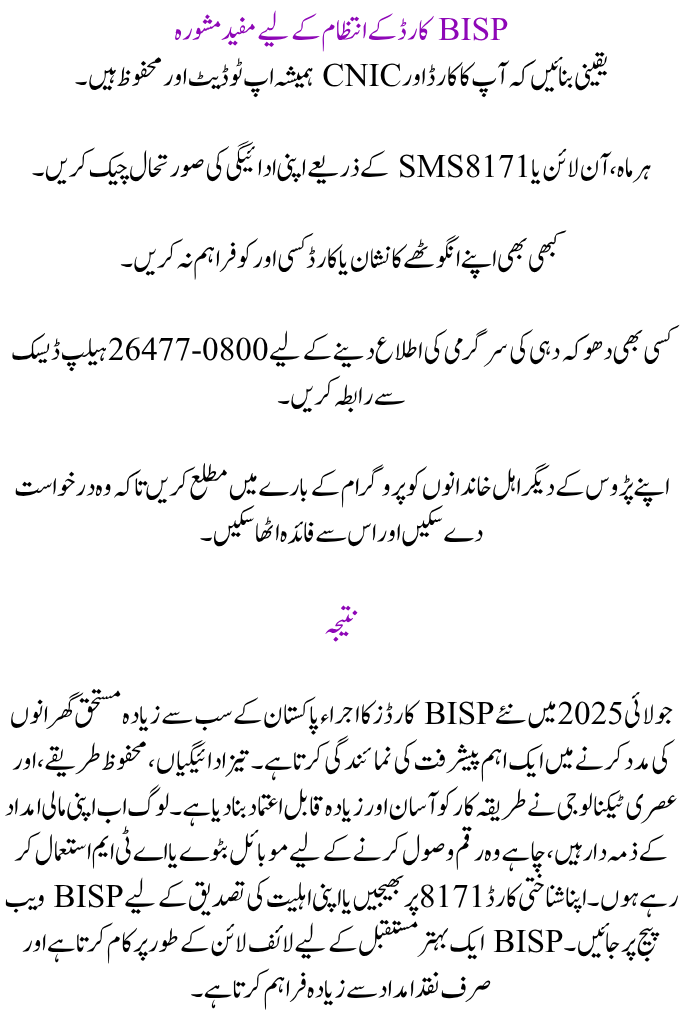
Helpful Advice for BISP Card Management
- Make sure your card and CNIC are always up to date and secure.
- Every month, check your payment status online or via an 8171 SMS.
- Never provide your thumbprint or card to someone else.
- Contact the 0800-26477 help desk to report any fraudulent activity.
Inform other worthy families in your neighborhood about the program so they may apply and take advantage of it.
Conclusion
The July 2025 rollout of the new BISP cards represents a major advancement in helping Pakistan’s most worthy households. Faster payments, secure ways, and contemporary technology have made the procedure easier and more reliable. People are now in charge of their financial assistance, whether they are using mobile wallets or ATMs to receive money. Send your CNIC to 8171 or go to the BISP webpage to verify your eligibility. BISP serves as a lifeline for a better future and provides more than just cash assistance.
FAQs
1. In July 2025, who will be eligible for the new BISP card?
According to the PMT score, low-income families making less than Rs. 50,000 per month are eligible for the new BISP card. Widows, divorced women, transgender people, single moms, and families with crippled orphans are given preference. Candidates must possess a current, valid CNIC.
2. How can I use the new BISP card to withdraw Rs. 13,500?
Visit an approved ATM, bank branch, mobile wallet agent, or BISP payment center after getting an SMS from 8171 verifying payment readiness. Present your CNIC and BISP card, verify your biometric fingerprint, and take out the entire Rs. 13,500 without any deductions.
3. What errors should I steer clear of while using the new BISP card?
Don’t use a CNIC that has expired, keep your SIM connected to your CNIC, update your biometrics if they aren’t functioning, and only go to the bank or center that you were allocated. Every BISP service is entirely free; never pay someone for quicker service.